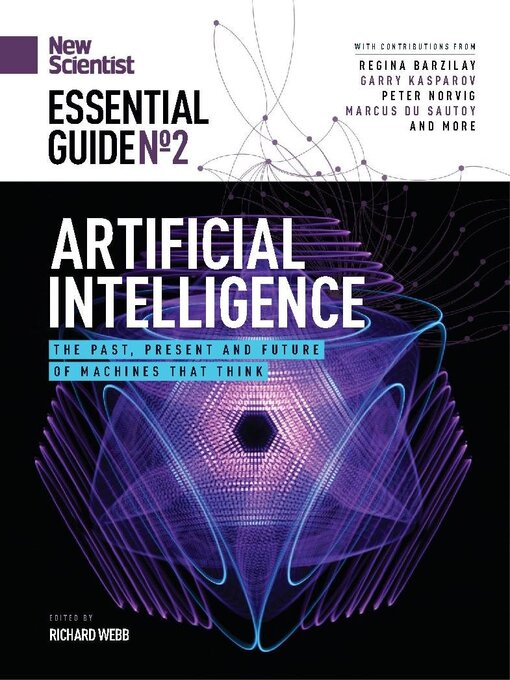
 EG25
 EG24
 EG23
 EG22
 EG21
 EG20
 EG19
 EG18
 EG17
 EG16
 EG15
 EG14
 EG13
 EG12
 EG11
 EG10
 EG09
 EG08
 EG07
 EG06
 EG05
 EG04
 EG03
 EG02
The Essential Guide series brings together the best recent coverage from New Scientist specially curated into beautiful compendiums about the most exciting themes in science and technology today. Written and edited by some of the world’s best science writers, these guides will leave you with everything you need to know about subjects from nutrition to the solar system and more.
ARTIFICIAL INTELLIGENCE
New Scientist - The Essential Guides
WHAT AI IS – AND ISN’T • The idea of artificial intelligence both thrills and disturbs. What are we to make of devices that can understand and respond to our voice commands, of super-powerful search engines that anticipate what we want to know, of cars that can drive themselves?
TURING’S LEGACY • Alan Turing is feted as the father of computer science, as well as being a visionary thinker on artificial intelligence. He devised the Turing test, which is still the key gauge of how close machines have come to human intelligence, as well as publishing some prescient ideas about how to simulate the human brain with computers.
WHAT IS INTELLIGENCE, ANYWAY? • Intelligence has enabled humans to reach for the moon, cure disease and generally dominate this small blue dot of a planet. So if we grant machines intelligence, will it do all that? That depends on how we define the concept in the first place.
HOW MACHINES LEARN • On the question of whether machines can learn, at least one computing pioneer knew well where she stood. “The Analytical Engine has no pretensions whatever to originate anything,” said Ada Lovelace in 1843, referring to the computing machine proposed by her collaborator Charles Babbage. “It can do whatever we know how to order it to perform.”
A TIMELINE OF AI • While the idea of AI has been around for the best part of 70 years, in the first few decades progress was halting and slow. It was only in the late 1980s with the discovery of a new, bottom-up paradigm of machine learning, based on algorithms capable of drawing statistical inference from large amounts of data, that AI began to find its way. Just a few years later, the advent of the world wide web began to provide a ready, ever-growing source of that data.
WHAT MAKES MACHINE LEARNING DIFFERENT?
DATA, DATA, DATA • Many of the AI systems we interact with day-to-day have a feature in common – they “understand” written or spoken human language. It’s a clever feat, to be sure, and it’s an example of how AI feigns intelligence it doesn’t really have. At its heart lies probability, statistics and…
THE POWER OF DEEP LEARNING • Statistical analysis of past interactions to anticipate present behaviour is one thing. Dealing with novel situations is another. Who can you recommend a brand new book to, say, or what should an autonomous car do when it detects an unexpected movement on the road in front of it?
WHAT IS A NEURAL NETWORK?
AI VS HUMANS • The story of AI so far can be told through a series of episodes where they’ve beaten us at our own game – literally.
Deep Blue 2 vs Garry Kasparov, 1997 • This match still remains seared on many minds as the first time a silicon mind beat the best human competitor at an iconic intellectual pursuit. Ultimately, however, this was a victory more for computing brawn than brain.
IBM Watson vs Jeopardy!, 2011 • Unlike the rules of chess, the rules of human language are complex – or non-existent. Understanding human communication is an impossible ask for a computer that follows hard-programmed rules alone. But exploit statistics, probability and a lot of data, and you don’t need rules. That was the secret of AI’s next big leap forward, a bot that was a bit of a whizz at a quiz.
AlphaGo vs Lee Sedol, 2016 • The triumphs of Deep Mind 2 and Watson in their respective games both pushed the boundaries of machine...